Understanding Hand Arthritis:
What It Is, Why It Happens, and What We Can Do About It
Do you or someone you know struggle with hand pain and swelling? It’s a common problem, and it becomes more frequent as we age. Many patients describe their hands as feeling frozen, stiff, or stuck. And when arthritis settles into your hands, you’re reminded just how much you rely on them for nearly everything you do throughout the day. We all like to escape the rainy winters here on the west coast, but sometimes these patients will book a trip south just to try to escape the hand pain they are having on a daily basis.
The most common complaints we hear are pain and weakness when gripping, swelling of the fingers, and reduced movement, particularly in the morning or after rest. This article will walk you through what hand arthritis actually is, why it happens, and what can be done to help.
What Causes Arthritis in the Hands?
Because the fingers aren’t weight-bearing joints, everyday “wear and tear” is unlikely to be the main driver of hand arthritis. That said, occupations that place heavy demands on the hands (mechanics, labourers, chiropractors, and massage therapists, for example) may carry some added risk.
More often, the causes are internal. General inflammation throughout the body appears to play a role, and there’s a strong genetic component — if your parents or grandparents had prominent finger nodes, you’re more likely to develop them too. Arthritis can also be more likely to appear following surgery, trauma, or a significant injury to a joint.
At the tissue level, our joints are lined with cartilage, and the health of that cartilage depends on cells called chondrocytes that build and maintain it. As we age, our ability to repair this tissue gradually declines — which is why arthritis becomes more common later in life.
But here’s the encouraging part: arthritis does not mean you’re destined to live in pain. The pain itself comes from local joint irritation and inflammation — not simply from the presence of arthritis. While the underlying joint changes (and bony growth) can’t be reversed, the swelling and irritation that actually cause discomfort can very often be reduced through diet, exercise, better sleep, improving your overall health, and targeted treatment such as Class IV laser therapy.
How Is Hand Arthritis Diagnosed?
Hand arthritis is usually straightforward to identify. On examination, range of motion is limited, gripping or using the hands brings on pain, and stiffness tends to be worse in the morning or after periods of inactivity. Typically, the pain eases with rest and worsens with use.
Two hallmark signs help confirm the picture:
- Heberden’s nodes – firm, bony enlargements that form at the distal joints, the ones closest to your fingertips.
- Bouchard’s nodes – similar enlargements at the proximal interphalangeal joints, the middle knuckles of the fingers.
These nodes develop from chronic bony change as the cartilage lining the joint breaks down. During active or inflammatory phases, you may also notice softer tissue swelling, which is distinct from the permanent bony enlargement.
In most cases, your chiropractor or physician can diagnose hand osteoarthritis confidently from your history and physical exam alone. Sometimes, however, X-rays or blood work are helpful — X-rays can confirm the characteristic joint changes, and blood tests help rule out other conditions that can affect the hands, such as rheumatoid arthritis, gout, or psoriatic arthritis.
Why and How Does Treatment Help?
Patients often ask a very reasonable question: how can any treatment help when the joint already shows signs of damage and wear? Isn’t the problem already there?
The answer lies in what’s actually causing your symptoms. It’s not the “worn-out” cartilage itself or even the bony growth that is causing the pain. Cartilage itself has no nerve endings and doesn’t cause pain. The discomfort comes from the surrounding tissues, especially the synovium, the delicate lining of the joint. When the synovium becomes swollen and inflamed, it increases pressure within the joint, which restricts movement and generates pain. Inflammation is a chemical process, causing you to feel pain as the chemicals are release into the tissues and picked up by the surrounding nerves.
This is where treatment makes a difference. By calming the inflammation, joint swelling and pressure, we can improve range of motion, decrease pain, and restore strength and dexterity — even though the underlying arthritis remains. In other words, we’re treating the part of the problem that’s actually generating your symptoms.
Our Approach: A Combined Care Plan
We find the best results come from layering several complementary strategies rather than relying on any single treatment.
Class IV Laser Therapy
We use LiteCure® Class IV laser — a high-intensity photobiomodulation therapy applied directly over the affected joints. The proposed mechanism centres on improving local circulation and modulating inflammatory activity in the synovium and surrounding tissue, which is thought to help reduce swelling, ease pain, and improve joint mobility over a course of treatment. A typical protocol runs three sessions per week for three to four weeks (roughly 8–12 visits in total).
We think it’s important to be transparent about the evidence. The research specifically on finger-joint arthritis is promising but mixed. One study following 34 patients with Heberden’s and Bouchard’s arthritis found meaningful reductions in pain and swelling and improved range of motion after a course of laser therapy — though that study didn’t include a placebo comparison group. Other controlled trials on hand arthritis haven’t shown a clear benefit over sham treatment. Our clinical experience has been positive, and we believe the treatment is well worth trying, but we want our patients to understand it as a supportive therapy for symptoms — not a cure, and not a treatment with fully settled research behind it. Read more about Litecure Class IV laser therapy here.
Having said that, we have included a story at the bottom of this article of a patient that had great success using the laser for their hand osteoarthritis. Please continue to the bottom of this article for that story.
Self-Directed Joint Traction
A simple technique we teach patients is gentle long-axis traction — lightly pulling along the length of the finger to create a brief distraction at the joint, then releasing. Done in short holds (10–12 repetitions, twice daily), it’s a low-risk way to take an active role in managing your own symptoms between visits.
Daily Hand Exercises
A short, consistent hand exercise routine helps preserve range of motion and function — something leading rheumatology and physical therapy guidelines consistently recommend as a foundation of hand arthritis care. Our go-to routine includes:
- Tendon glides – cycling through hook fist, straight fist, and full fist positions
- Thumb-to-fingertip opposition – touching the thumb to each fingertip in sequence
- Table-top finger spreads – spreading and closing the fingers against a flat surface
- Gentle isometric grip work – squeezing a soft ball or putty
- Thumb web-space stretching – especially helpful when the base of the thumb is involved
None of these need to take more than a few minutes a day, and most patients find they can do more with their hands once the routine becomes a habit.

Ice and Joint Protection
Ice after activity or during flare-ups helps manage acute swelling. Just as important — and often overlooked — is joint protection: using built-up grips, jar openers, and key turners, and pacing repetitive hand tasks throughout the day rather than pushing through them. Small adaptations add up to meaningfully less strain on already-irritated joints.
Nutritional Support
We also talk with patients about nutritional strategies that may help address the inflammatory side of the picture. Omega-3 fatty acids, glucosamine and chondroitin, and curcumin-based anti-inflammatories all have a role in the broader conversation — though it’s worth knowing that the dose shown to have a real anti-inflammatory effect in research is often higher than a bottle’s standard serving size suggests. This is a good conversation to have directly with your provider, since appropriate dosing and product selection matter more than most people expect.
When to Involve Someone Else
Conservative care is the right starting point for the large majority of hand arthritis cases, but there are times we’ll point patients toward additional support:
- Occupational therapy or hand therapy for custom splinting, particularly useful during flare periods
- Topical anti-inflammatory medication, which is actually considered a first-line option for hand arthritis symptoms
- Physician or rheumatology referral if we notice red flags – swelling at the knuckle or wrist joints, morning stiffness lasting over an hour, or unusually acute, hot, single-joint symptoms – since those patterns can suggest something other than typical osteoarthritis
- Surgical consultation, reserved for the smaller number of patients whose symptoms don’t respond adequately to conservative care over time
The Bottom Line
Hand osteoarthritis is common, it’s shaped largely by your genetics and biology rather than simple “wear and tear,” and – while it can’t be reversed – it responds well to a layered, consistent approach. If you’ve noticed new stiffness, swelling, or those telltale bumps at your finger joints, we’d encourage you not to simply wait it out. Early, consistent management tends to preserve function far better than treatment started after years of unaddressed symptoms.
If any of this sounds familiar, our team would be glad to build a personalized plan with you.
For a copy of the Hand OA Home Care Guide PDF please go to our resources page.
This article is for general education and does not replace individualized medical advice. Please consult your healthcare provider about your specific situation.
Patient Success Story:
Finding Relief from Hand Arthritis with Class IV Laser
As promised earlier in this newsletter, here’s a real example of what treatment can do.
First off, not everyone responds the same way, and we can never promise a cure. But every so often, a patient’s results are striking enough that we want to share them – with their permission, and with their identity kept confidential.
The Patient’s Story
D.B., a patient from Tsawwassen, came to us with near-constant pain and soreness throughout both hands – most prominent at the index fingers. The discomfort was a daily reality: worse in the mornings, worse with grasping, and accompanied by constant stiffness and swelling across all five fingers on each hand.
The swelling and pain significantly limited his ability to grasp or grip objects, and his range of motion was greatly reduced. The pain was often sharp, especially at the index fingers when grasping certain objects. His diagnosis of osteoarthritis was confirmed on X-ray.
Perhaps most telling of all: the pain was severe enough that it heavily motivated trips to warmer, drier climates each winter just to find some relief – the kind of life adjustment that shows just how much hand arthritis can affect everyday living.
Setting Honest Expectations
As we mentioned earlier in this newsletter, we never want to over-promise — every patient is different, and results are not guaranteed. But we explained that a course of LiteCure® Class IV laser therapy might be worth trying, since many patients do find meaningful relief. The plan was straightforward: treatment three times per week for about a month, with 10 minutes of laser applied to each hand.
The Results
D.B.’s response was faster than we expected.
He noticed considerably less stiffness even after the very first visit — and his pain continued to decrease progressively over the following sessions. By the end of a total of 13 visits over five weeks, we discharged him from care, having felt what we believed to be maximum therapeutic benefit.
At discharge, D.B. had almost no hand discomfort when grasping and was genuinely amazed at the results. His hand range of motion had improved dramatically as well.
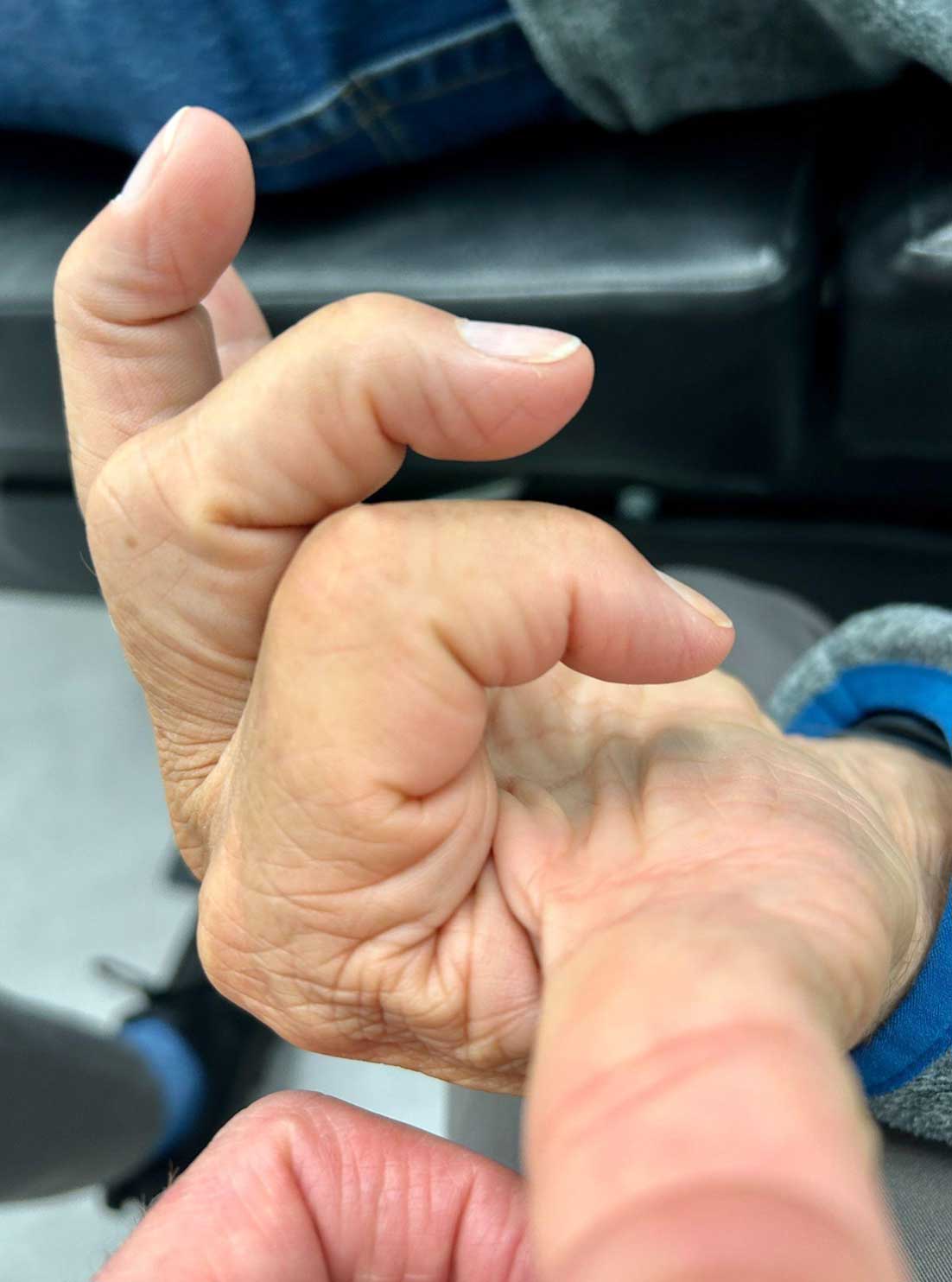
The photos below tell the story clearly. In each photo D.B. was asked to flex his index finger as far as possible. We chose the index finger as that was his most symptomatic.
Day One: the movement was painful, and range of motion was limited.
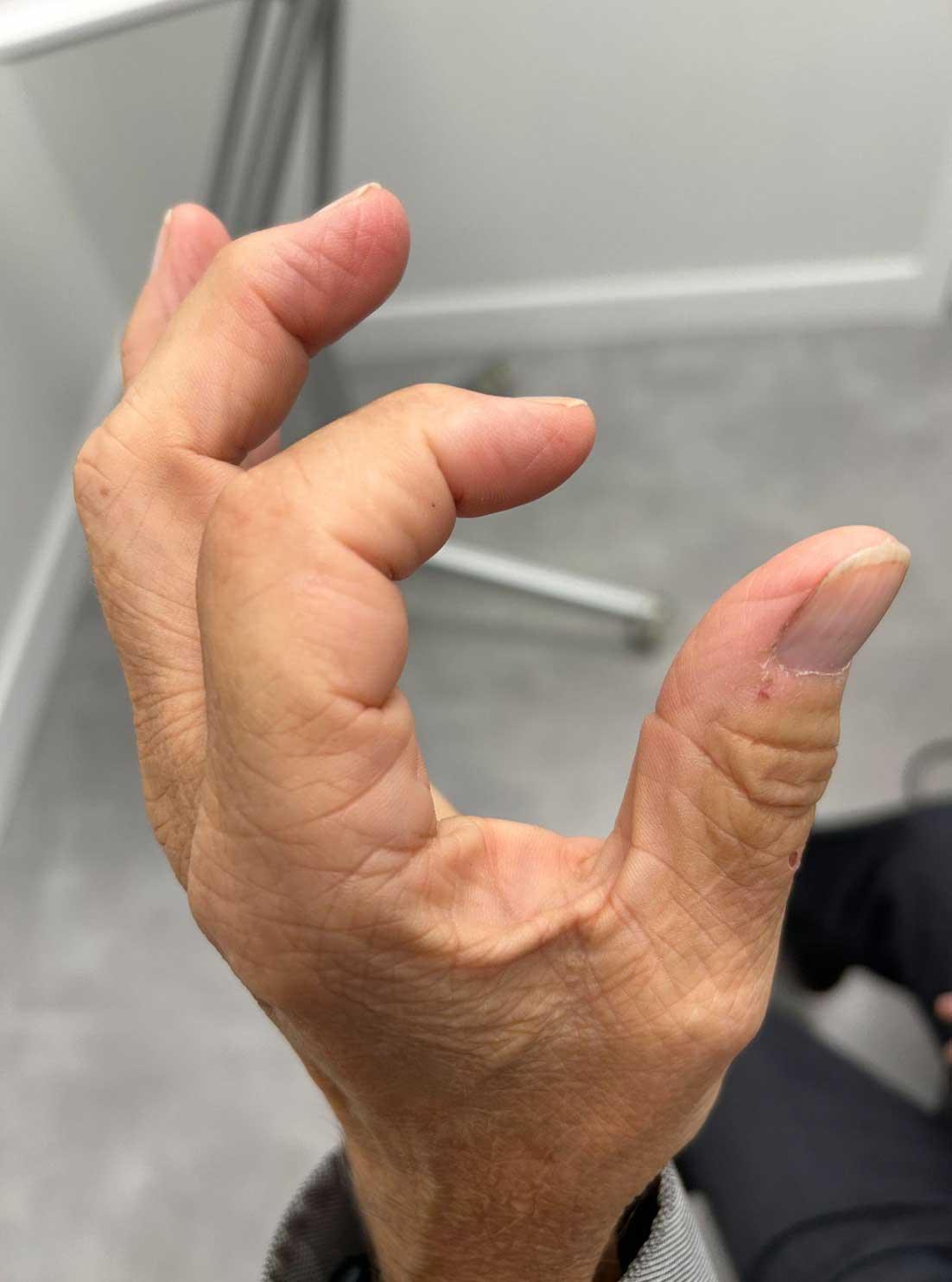
Week Five: there was no pain, and his range of motion was dramatically improved.
The Takeaway
D.B.’s experience is a wonderful example of what’s possible for some patients with class IV laser therapy. Not every patient will have this outcome, but usually after a few weeks we can determine if the results are positive and whether we need to try another approach or send a referral to someone else that may be able to help. There aren’t a huge number of options for treatment for hand arthritis so we think this should really be considered and more widely available to those that need help.
We’d love to talk with you about whether Class IV laser therapy or another part of our combined care plan might be a good fit. We have even put together a handout for patients, friends or family looking for help suffering from hand osteoarthritis here.